

You just closed your seed round. Your investors want growth numbers by next quarter. The last agency you hired burned through $30K and delivered a brand guidelines PDF.
This post breaks down what actually matters when picking a marketing agency for startups — and what to run from.
What Most Agencies Get Wrong About Startup Marketing
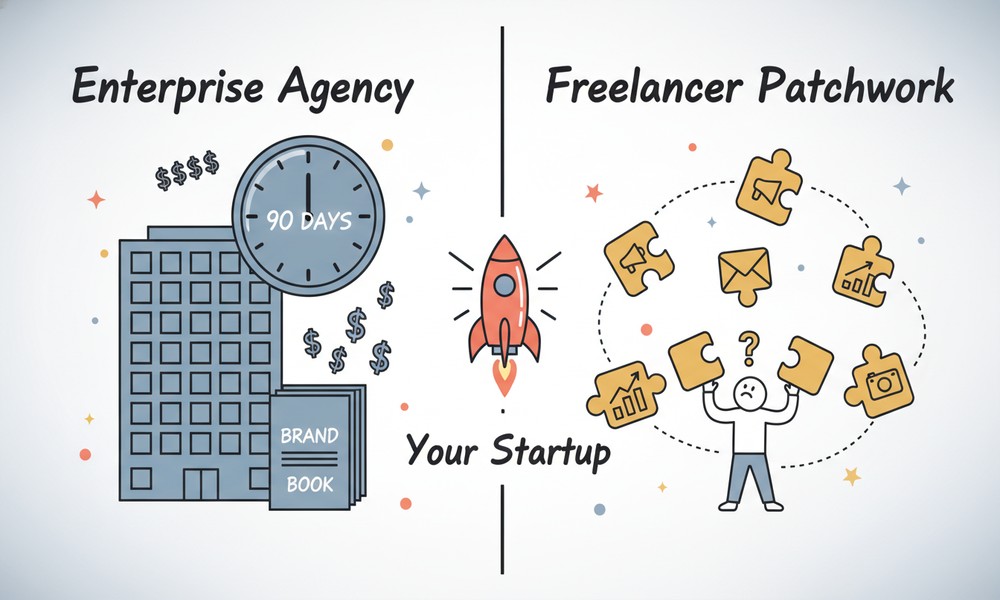
Enterprise agencies treat your startup like a miniature Fortune 500. They pitch 90-day “discovery phases” and six-figure retainers. They don’t understand that you need pipeline this month, not a polished brand book next quarter.
Boutique freelancers go the other direction. They know one channel well but can’t connect paid acquisition to your activation funnel. You end up project-managing five contractors who never talk to each other.
The real problem is simpler than either extreme. Most agencies have never operated inside the pressure of a startup burn rate. They don’t report in metrics your board cares about. They don’t know what a Series A timeline looks like.
If your agency can’t explain how their work moves your next fundraise forward, they’re the wrong agency.
What a Good Startup Marketing Agency Actually Does
Understands Venture-Backed Growth Timelines
Your runway is 18 months. A good agency builds backward from your next milestone. They know the difference between pre-seed traction and Series A scale.
Covers Strategy Through Execution
You don’t need a strategist who hands off a deck. You need a team that builds the campaigns, runs the ads, and optimizes the landing pages. A full-service marketing agency eliminates the gap between plan and action.
Reports Metrics Your Board Reads
CAC, LTV, payback period, channel-level ROAS. Not impressions. Not “brand awareness.” If the dashboard doesn’t connect spend to revenue, it’s decoration.
Has Startup-Specific Pattern Recognition
Agencies that have scaled 100+ venture-backed companies know what works at $500K ARR versus $5M ARR. They’ve worked inside portfolios from YC, Sequoia, and a16z. That pattern recognition saves you months of testing.
Offers Transparent, Flexible Pricing
Startups don’t sign 12-month contracts blindly. Look for month-to-month options and clear scope breakdowns. If the pricing feels opaque, it probably is.
Five Habits That Separate Good Agency Hires from Bad Ones
Ask for startup case studies, not enterprise logos. A case study showing 37% CAC reduction for a Series A company tells you more than a Fortune 500 brand logo on their homepage. Demand specifics: starting budget, timeline, measurable outcome.
Run a 30-day paid test before committing. Any confident agency will agree to a short trial. Set a clear KPI upfront. If they push back, they’re hiding behind long contracts for a reason.
Check their reporting cadence. Weekly async updates and monthly strategy calls is the minimum. If they only surface when the invoice is due, you’ll waste months before catching underperformance.
Verify they use AI-powered workflows. Manual campaign management is too slow for startup iteration speed. The best agencies use automation for bid management, creative testing, and marketing agency reporting dashboards that update in real time.
Talk to their former clients. References they hand-pick will always glow. Find a founder who churned and ask why. The answer tells you more than any sales call.
Your Competitors Already Hired One
The median Series A startup now allocates 30-40% of its budget to growth marketing. The ones doing it well aren’t figuring it out internally with a single marketing hire. They’re using agencies with startup-native DNA.
Every month you spend on the wrong agency — or no agency — is a month your competitors are compounding their advantage. They’re building retargeting audiences, ranking for your keywords, and locking in lower CPAs while the channels are still affordable.
The math is straightforward. A good startup marketing agency pays for itself within 90 days through lower acquisition costs and faster pipeline velocity. A bad one costs you two quarters and your board’s confidence.
You don’t have the runway to learn this lesson twice.