

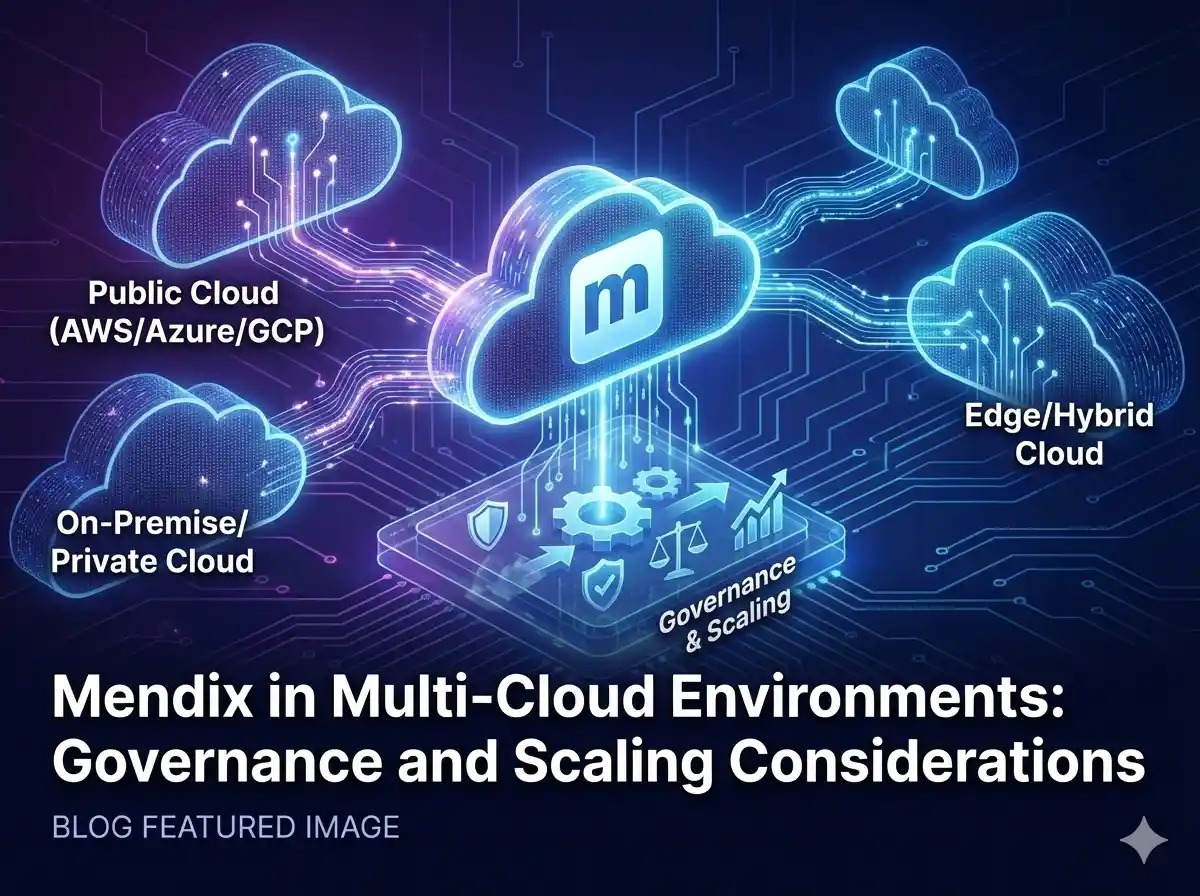
Multi-cloud is no longer a trend. For large enterprises, it has become a strategic necessity.
Organizations today distribute workloads across AWS, Azure, private cloud, and sometimes on-premise infrastructure — not for experimentation, but for control. Regulatory compliance, vendor diversification, latency optimization, and risk mitigation all drive multi-cloud adoption.
When deploying Mendix in such environments, however, architectural discipline becomes critical. Multi-cloud introduces operational flexibility — but it also multiplies governance complexity and scaling risks.
Enterprises that succeed with Mendix in multi-cloud environments do not treat it as a simple infrastructure decision. They treat it as a long-term architectural strategy.
Why Enterprises Adopt Multi-Cloud for Mendix Workloads
There are several common drivers:
- Data sovereignty requirements across regions
- Redundancy and disaster recovery planning
- Vendor lock-in avoidance
- Regulatory segmentation of sensitive workloads
- Latency optimization for global users
While these drivers are legitimate, distributing Mendix workloads across multiple cloud providers increases architectural surface area.
Without disciplined governance, multi-cloud environments can become fragmented ecosystems rather than strategic infrastructure.
Governance as the Primary Control Layer
In single-cloud environments, governance is already complex. In multi-cloud, it becomes foundational.
Effective governance must address:
- Standardized deployment pipelines
- Environment configuration consistency
- Security policies across providers
- Version control discipline
- Centralized monitoring
Multi-cloud governance is not about restricting teams. It is about preventing drift.
Drift occurs when:
- One environment implements a different security configuration
- Logging standards vary between providers
- Autoscaling rules are inconsistent
- Identity policies diverge
Over time, these inconsistencies introduce operational risk.
Structured oversight from an experienced Mendix Consultant can help enterprises define governance models that scale across cloud boundaries without sacrificing agility.
Architecture Before Infrastructure
Enterprises often begin multi-cloud journeys at the infrastructure level — selecting providers, defining networking, provisioning clusters.
However, Mendix multi-cloud success depends first on application architecture.
Architectural best practices include:
- API-first communication between services
- Clear separation of stateless and stateful components
- Externalized configuration management
- Explicit transaction boundaries
- Loose coupling between modules
Multi-cloud amplifies the consequences of tight coupling.
An application that depends heavily on provider-specific services becomes difficult to port or scale across environments.
Architecture must preserve portability.
Scaling Across Providers Without Fragmentation
One of the perceived benefits of multi-cloud is elastic scalability. But scaling across providers introduces synchronization challenges.
Enterprises must carefully define:
- Horizontal scaling policies
- Database replication strategies
- Cache consistency mechanisms
- Traffic routing rules
- Load balancing across regions
Scaling is not just about adding runtime instances. It is about ensuring consistency across distributed systems.
In multi-cloud Mendix environments, database strategy often becomes the most critical scaling variable. Distributed database architectures require careful replication and failover planning to prevent data inconsistency.
Poor planning in this layer can undermine the benefits of multi-cloud flexibility.
Security Standardization Across Clouds
Security inconsistencies represent one of the most common failure points in multi-cloud architectures.
Each cloud provider has:
- Different IAM models
- Unique networking constructs
- Distinct logging mechanisms
- Separate monitoring dashboards
Without a unified security policy framework, multi-cloud quickly becomes a compliance risk.
Enterprises should enforce:
- Centralized identity federation
- Unified access control standards
- Standardized encryption policies
- Cross-cloud security monitoring
Security must operate independently of provider-specific tooling.
Observability in Distributed Environments
Multi-cloud environments increase observability complexity.
Architects must ensure:
- Correlated transaction identifiers across clouds
- Centralized logging aggregation
- Unified performance dashboards
- Alert consistency across regions
Fragmented monitoring leads to slower incident response times.
Distributed systems require distributed visibility — but with centralized insight.
Observability is not optional in multi-cloud environments. It is what makes distributed architecture manageable.
Cost Governance and Financial Predictability
Multi-cloud adoption often aims to optimize cost through vendor diversification. However, without disciplined oversight, cost fragmentation can occur.
Enterprises must monitor:
- Cross-cloud data transfer costs
- Duplicate infrastructure allocation
- Idle runtime resources
- Logging and storage overhead
Cost governance requires continuous evaluation.
Organizations that treat multi-cloud as a flexible expansion model without financial discipline may see unpredictable billing patterns.
Structured cost review frameworks are essential for sustainable scaling.
Organizational Alignment and Operating Model
Technology alone does not determine multi-cloud success.
Enterprises must align:
- DevOps teams
- Security teams
- Compliance stakeholders
- Application architects
- Platform governance leaders
Multi-cloud introduces operational interdependencies. Clear ownership models prevent accountability gaps.
Some enterprises partner with a mature low code company experienced in distributed cloud environments to accelerate operational maturity and prevent early architectural missteps.
This is particularly important when multi-cloud initiatives expand beyond initial pilot programs into enterprise-wide adoption.
Avoiding Over-Engineering
While multi-cloud offers strategic advantages, not every Mendix workload requires distribution across providers.
Architects should evaluate:
- Regulatory necessity
- Latency requirements
- Redundancy needs
- Operational readiness
Over-engineering infrastructure introduces complexity without proportional benefit.
The most effective multi-cloud strategies are intentional — not reactive.
The Strategic Outcome
When governed correctly, multi-cloud Mendix deployments provide:
- Greater infrastructure flexibility
- Reduced systemic risk
- Improved global performance
- Enhanced regulatory alignment
- Vendor diversification
But these benefits emerge only when governance and architecture remain aligned.
Multi-cloud is not inherently superior. It is superior when managed with discipline.
Enterprises navigating multi-cloud Mendix deployments often benefit from structured architectural guidance to align governance, scalability, and compliance across environments. Teams such as We LowCode work alongside enterprise stakeholders to design distributed Mendix architectures that remain secure, portable, and operationally resilient as cloud strategies evolve.
Conclusion
Deploying Mendix in multi-cloud environments requires more than infrastructure distribution. It demands unified governance, architectural portability, security standardization, and financial discipline.
Enterprises that approach multi-cloud strategically create resilient, scalable platforms capable of evolving with regulatory and market demands. Those that treat it as a simple expansion strategy risk fragmentation and operational instability.
Multi-cloud success is not defined by the number of providers used — but by the coherence of the architecture across them.